
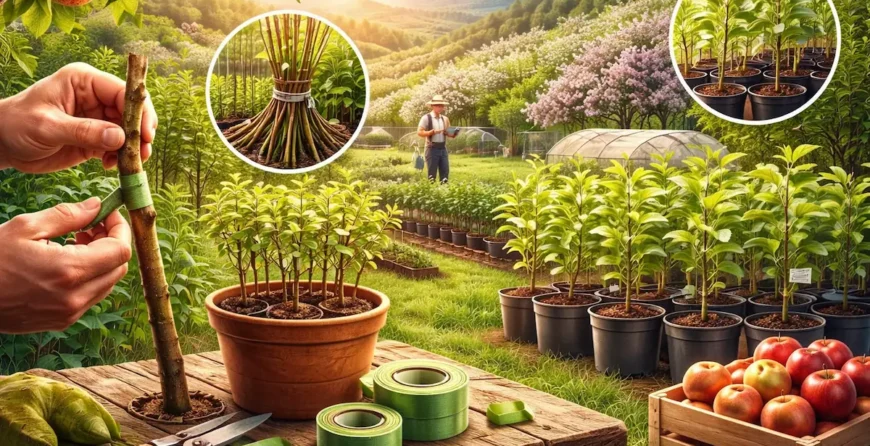
Apple grafting and nurseries are other sources of income.
Apple grafting and nurseries Additional sources of income include. Apple orchards are usually seen as long-term investments, and their main source of income is fruit harvesting. However, an increasing number of orchard owners are finding that apples offer a powerful substitute for fruit production: nursery plants and grafting income.
This change is not coincidental. There is now room for orchardists to make money by growing apple trees themselves due to the increased need for high-quality planting material, novel varieties, and dependable rootstocks.
The Reasons for Today’s High Demand for Nursery Plants
The patterns of apple cultivation have evolved dramatically during the past ten years. Farmers are no longer content with any sapling that is available; instead, they search for: Known types Consistent growth Potential for early bearing Dependable performance
The reliance on organized nurseries has grown as a result. But supply frequently falls short of demand, particularly for more recent or foreign kinds. Orchard farmers that already maintain healthy mother plants now have a chance thanks to this gap.
A Natural Transition from Orchard to Nursery
The most important resource for nursery work is already available to orchard owners: certified plant material. Scion wood is best obtained from trees that thrive in the local environment. Rather of only offering fruit for sale, producers can: Choose robust, true-to-type trees.
For grafting, use their scion wood. Grow plants that are climate-adapted Even small producers can make this move because it doesn’t initially require a lot of infrastructure.
Apple grafting and nurseries are becoming an important source of income for orchard farmers.
Recognizing the Grafting Advantage.
Seldom are apple plants produced on their own roots. Growers can use grafting to combine: robust root systems (rootstocks) Fruit attributes that are desired (scion varieties) This combo enhances: Consistency Tolerance for disease Longevity of orchards Additionally, grafting is more cost-effective than seed-grown plants since it reduces the waiting time.
The cornerstone of a successful nursery is seedling rootstocks.
The majority of grafted apple plants start as seedling rootstocks. Before grafting, these are typically cultivated for one to two years from apple seeds. The main advantages of seedling rootstocks are: Robust anchorage Improved capacity to adjust to different types of soil less expensive than clonal rootstocks Raising their own seedlings gives growers complete control over plant quality and lessens their reliance on other vendors.
A skill-based source of income is grafting.
Grafting income is more dependent on ability than land area, in contrast to fruit harvest. If correctly handled, a small space can yield hundreds of grafted plants. This is why grafting is appealing: The weather has no bearing on returns. Income is dispersed throughout the year. The need for labor is manageable. Many orchard families make grafting into a household business by involving several generations in the process.
Plant QualityApple grafting and nurseries also provide long-term income opportunities for orchard owners in Himachal Pradesh. and Customer Confidence.
Buyers of plants are wary. One negative encounter might permanently destroy trust. Effective nursery growers concentrate on: Accurate labeling Robust root systems Scion free of disease wood Because customers may view the parent trees and orchard conditions, plants grown inside orchards frequently acquire trust more quickly.
Seasonal Planning and Timing Fruit production uses a different calendar than nursery operations. Among the activities are: planting seeds Care for seedlings Hardening plants for sale during the grafting season Orchard owners can continue to be productive even outside of the fruit harvest months thanks to this staggered timeframe.
Comparison between Fruit and Plant Incomes
While market pricing determine fruit sales, nursery plants can provide more consistent profits. Every plant that has been successfully grafted is a fixed asset. Benefits consist of: Reliable pricing Reduced transportation losses No need for cold storage Plant sales now make up a sizable amount of some producers’ yearly revenue.
Controlling Risks in the Production of Nurseries
Working in a nursery is hardly risk-free. Among the difficulties are: Failure of the graft Transmission of diseases Unsold stock However, there are ways to lower risks: Scaling gradually Practices of hygiene Plant production is determined by verified demand. Skilled farmers steer clear of overproduction and prioritize quality over quantity.
Ethical Conduct and Regulatory Awareness
Selling planting supplies entails accountability. Sincere growers guarantee: Accurate portrayal of variety No false statements Open and honest contact with purchasers Long-term reputation and recurring business are enhanced by ethical nursery practices.
Using Nursery Revenue as a Tool for Stability
Nursery revenue can serve as a safety net in years when fruit prices decline or output is impacted by weather. Over time, this diversification contributes to the stability of orchard economics. Nursery activity enhances fruit yield rather than replaces it, increasing the resilience of orchard income.
Conclusion: Moving Past Fruit and Toward Sustainability
Orchard owners’ perceptions of their land and abilities have changed as a result of apple grafting and nursery production. Growers may turn orchards into multi-income systems by combining traditional expertise with meticulous design.
This strategy focuses on creating long-term sustainability rather than short-term income, where apples provide families not just with fruit but also with plants that will influence orchards in the future.
According to research published by the Indian Council of Agricultural Research (ICAR), grafting improves plant uniformity and productivity in apple orchards.
